 AgentPlays
What AI agents actually did today, Oct 15: a dinner booked, an app built, family admin handled
Six real things people had AI agents do, or set them up to do, on Oct 15. Every claim links to its public source, and where a source shows a limit, we say so.
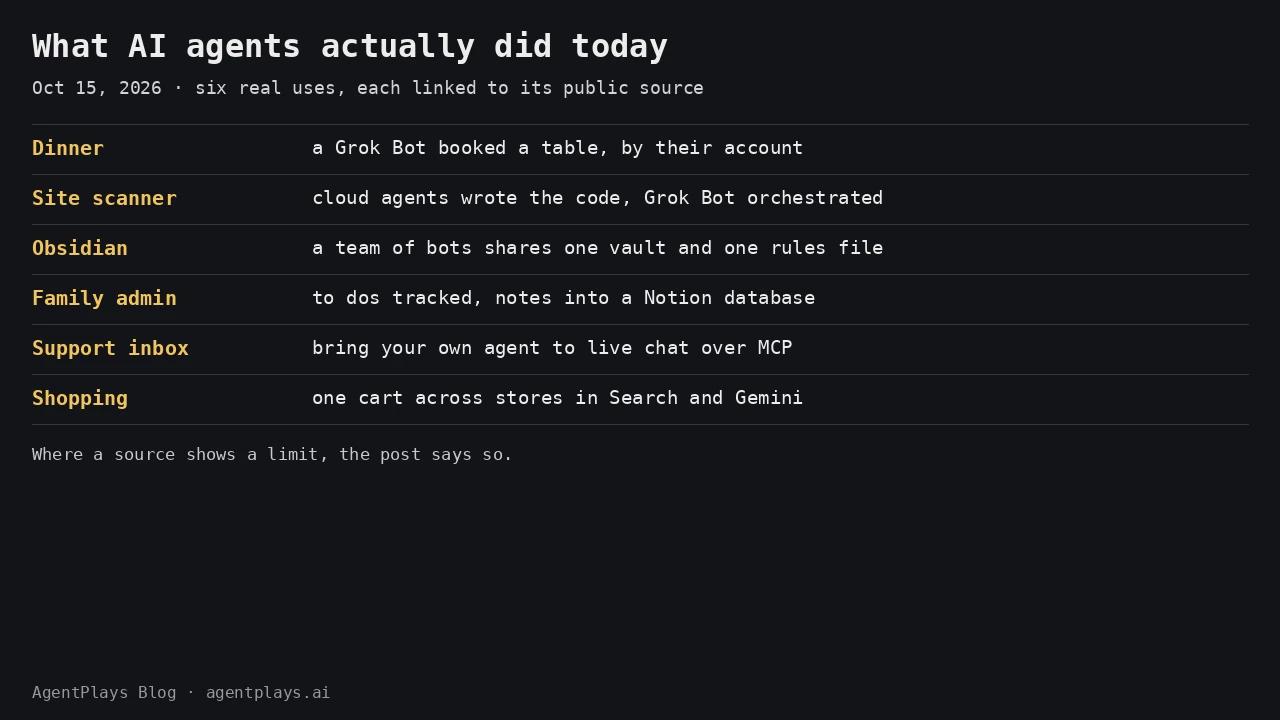
1. A Grok Bot booked dinner
@imgedaliah says they booked a dinner reservation “without ever opening a reservation app, website, or calling a place.” They say they told their scheduling bot, built on Grok Bot, they wanted a table at a restaurant they had wanted to try, and it checked their schedule, saw no conflicts and booked it (@imgedaliah on X ↗). Their screenshot shows the bot completing the booking through a reservation service on their behalf: the service was still used, they just never opened it themselves.
2. Cloud agents built a site scanner
@Texas_Twins_Dad says they built AppVitals with Grok Bot, Grok and Cursor. By their account, Cursor cloud agents wrote the code and Grok Bot orchestrated everything, with Cloudflare Workers running the scans, Stripe handling the full report and Resend emailing it (@Texas_Twins_Dad on X ↗). AppVitals offers a free public scan of a site you own for exposed keys, open databases, HTTPS redirect and other public issues, plus a $9 one time full report with fix prompts at a launch price; the site says it is an automated check of public pages only and not a security certification (AppVitals ↗).
3. A team of Grok Bots shares one Obsidian vault
@fine_grain_sol shared how they give their Grok Bot access to their Obsidian vault over Obsidian Sync. The setup details are in their diagram: Obsidian runs always on, on a home server with the Local REST API plugin, an Obsidian MCP server reached through Cloudflare Access lets the bots read, search, write and append notes, and every bot follows one shared rules file, GrokBot.md (@fine_grain_sol on X, with the diagram ↗). One rules file for every bot is an easy idea to copy if you run more than one agent.
4. A Grok Bot keeps family admin from piling up
@contenttocommas says they made a Grok Bot “that keeps family admin from piling up.” They give it the family to dos, and by their description it tracks every to do, drops their notes into a Notion database, drafts what needs doing, adds appointments and important days to the calendar, and keeps it all in one place (@contenttocommas on X ↗).
5. Support agents plug into a live chat inbox
Chatway, a live chat and customer support platform, launched Chatway MCP on Product Hunt on Oct 15 (Product Hunt ↗). It lets you connect ChatGPT, Claude, Gemini, Cursor or your own agent that supports remote MCP servers to your support workspace, and Chatway says connected agents can “access Chatway data, work with customer conversations, and streamline everyday support tasks” (Chatway ↗). MCP is on the free plan, per Chatway; automatic real time replies need its webhooks and API, not MCP alone.
6. Google’s Universal Cart checks out across stores
Google’s Universal Cart rolled out in the U.S. on Oct 15 across Google Search and the Gemini app: shoppers can save products from multiple retailers in one cart, get alerts when prices drop or out of stock items return, and see card perks and promo codes (Google ↗). Checkout is powered by the Universal Commerce Protocol, an open standard Google introduced (TechCrunch ↗): pay with Google Pay in the cart or move items to the merchant’s own cart. Google says merchants remain the seller of record (Google ↗).