 AgentPlays
Answer the messages a support bot missed during a server outage, then switch the catch-up off
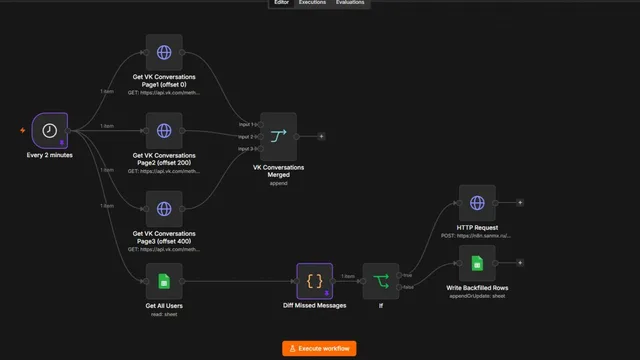
Freelance automation developer Dmitry Prozorovsky runs an n8n-based AI support bot for a motorcycle-gear shop's VK community. When the client's server went down for 17 hours, they built a recovery workflow: it reads the server's up/down history from an outside monitor, waits until the server is properly back, answers only the messages that never got a reply, then turns itself off.
Try it yourself
What you get
A recovery workflow that waits for a confirmed recovery, replies to every message missed during an outage, and then turns itself off.
Tools
- n8n
- External uptime monitor API
- VK community messages
- Tool-calling AI agent
Steps
- Watch the server from outside it, so the check still works when the server is down.
- After an outage, wait until the monitor history shows the server is stable again.
- Compare conversations with the bot's own records and reply only to messages that never got an answer.
- Look up live order status and prices at reply time, then switch the workflow back off.
Copy-ready prompt
Design an n8n recovery workflow for my support bot:
1. Trigger: poll [MONITOR] API every [N] minutes for my server's recent up/down history.
2. Start the backfill only after the server has been up for [N] minutes in a row.
3. Pull conversations from [CHANNEL] for the outage window and compare against the bot's reply log; keep only messages with no reply from the bot or a human.
4. Answer each one, fetching current order status and prices at reply time.
5. When the list is empty, deactivate the backfill workflow.
List the nodes, and how to avoid touching conversations a human is already handling.
Watch out: This comes from the monitoring vendor's blog. An always-on version first interfered with chats staff were handling by hand; keep it temporary.
Proof / source
Second-hand report Interview published by the monitoring vendor whose API the workflow uses (Oct 2026), not by the builder.
In their words
Build recovery tools to be self-limiting: something that watches for a real signal and then switches itself back off, rather than a patch that just runs forever and can end up causing its own bugs.
Read the original source ↗ Discussion ↗
Related
Let your AI agent do the bookkeeping legwork in Dougs while you approve every change
Tom Eberle open-sourced dougs-cli (MIT), an unofficial command-line tool for the French accounting platform Dougs, so an agent can work in their company's books. On their…
Get a second opinion on a $1,800 car repair quote from the shop's own inspection video
After a routine service, a shop recommended about $1,800 of work on Kyle Blanchard's Mazda and sent an inspection video. They gave an AI agent a photo of the quote and th…
Have a chief-of-staff bot restart a hung routine and explain why it stalled
@AdamLowisz's Grok Bot chief-of-staff noticed a hanging weekly routine ("X Top 100 Fans Weekly"), restarted it from where it stopped, explained it had pulled 631 posts th…
Get a daily Grok Bot ops report on Vercel spend, errors and failed deploys
LinXiaoTao stopped opening the Vercel dashboard every morning and set up a Grok Bot that posts a daily ops report in chat: spend against the Pro credit with an end-of-cyc…