 AgentPlays
Read an upside-down, blurry page scan with Indra OCR on a CPU
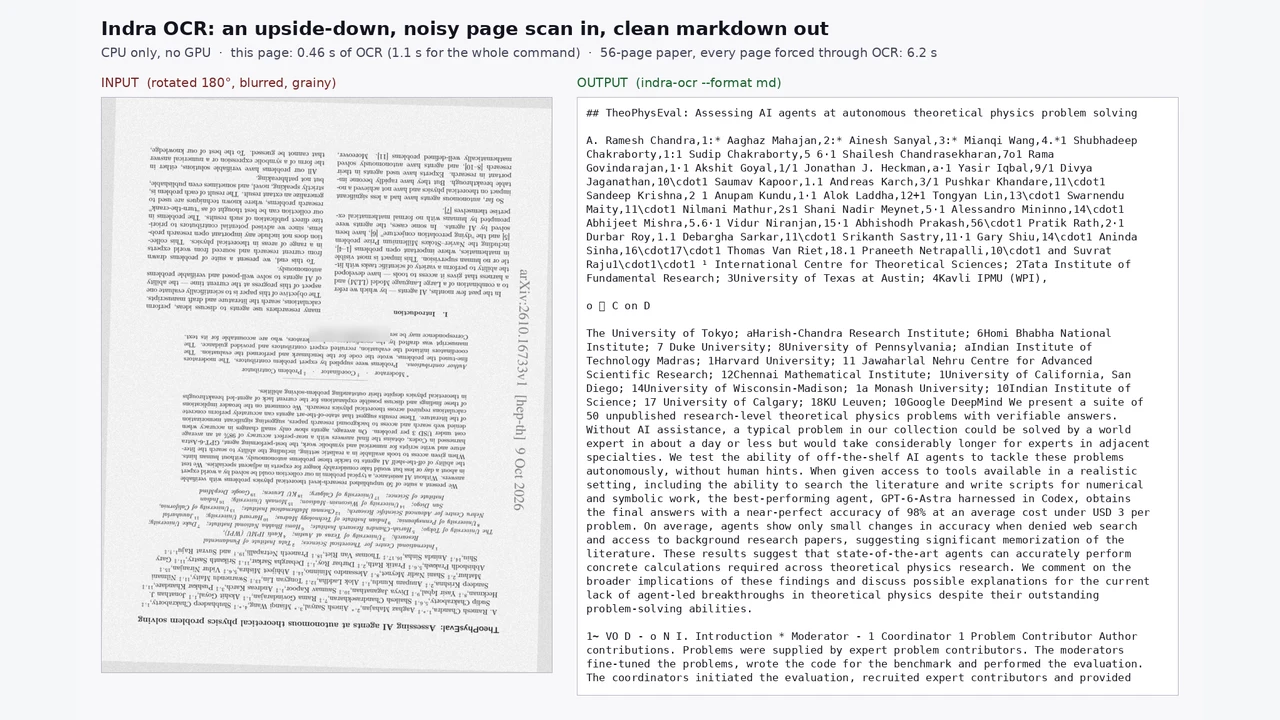
We tested Indra OCR (first published Oct 10–13) on an 8-vCPU Intel Xeon, CPU only. We gave it a page rotated upside down, blurry and grainy: page 1 of the TheoPhysEval paper. It turned the page upright and read the title, abstract and body cleanly. Superscripts and the sideways arXiv stamp came out garbled. 0.46 s of OCR, 1.1 s for the whole command (model already downloaded). A 56-page paper with every page forced through OCR took 6.2 s.
Try it yourself
What you get
Clean markdown text from a scanned page, even one that is upside down, blurry and grainy, with no GPU.
Tools
- Indra OCR (Datalab)
- Any recent CPU; we used an 8-vCPU Intel Xeon
Steps
- Install it with pip install indra-ocr (about 10 seconds in our test).
- Run indra-ocr on your scan or PDF with --format md; add --timings to see how long each page takes.
- For a PDF that already has a text layer, the default mode uses it; --mode ocr forces every page through OCR.
- Check superscripts, footnote marks and sideways text by hand: those came out garbled in our test.
Watch out: Code Apache-2.0. Weights: modified OpenRAIL-M, free for personal use, research, and organizations at or under $20M in revenue or funding; not for anyone offering a product that competes with Datalab's. No region limits.
Proof / source
Tested by AgentPlays Our own test on Oct 15, 2026, on an 8-vCPU Intel Xeon, CPU only: input scan, output text and timings. Model card on Hugging Face, code on GitHub.
Read the original source ↗ Discussion ↗
Related
Convert HTML to Markdown on a CPU with Microsoft MarkItDown
We tested Microsoft MarkItDown 0.1.8 on Oct 15: it converted Project Gutenberg ebook #4 (Lincoln's Gettysburg Address, HTML) to Markdown in 0.372 s wall-clock on an 8-vCP…
Remove an image background on a CPU with rembg
We tested rembg on Oct 15 with a self-made test image: a red circle with a yellow square on a green background. rembg (MIT) with the u2netp model (Apache-2.0, from U-2-Ne…
Let your AI agent do the bookkeeping legwork in Dougs while you approve every change
Tom Eberle open-sourced dougs-cli (MIT), an unofficial command-line tool for the French accounting platform Dougs, so an agent can work in their company's books. On their…
Get a second opinion on a $1,800 car repair quote from the shop's own inspection video
After a routine service, a shop recommended about $1,800 of work on Kyle Blanchard's Mazda and sent an inspection video. They gave an AI agent a photo of the quote and th…